
 A horse’s hooves are miracles of evolutionary bio-engineering.
Developed from the same primordial structure that in humans gave rise to one finger and fingernail, a horse’s hoof is strong enough to support its entire 1,200 pound weight. That weight travels down the bony column of the leg, which ends in a tiny bone — the coffin bone, or P3 — suspended in the center of the hoof. The hoof capsule that surrounds and supports that bone is tough enough to hold that bone in place when 1,200 pounds are pressing down on it, yet is adaptable enough to physically change shape in order to adapt to new terrains and environments.
The hard keratin of the hoof wall is able to withstand the brutal forces exerted by this huge animal as it travels over 30 miles per hour over hard surfaces, yet is flexible enough to twist and accommodate 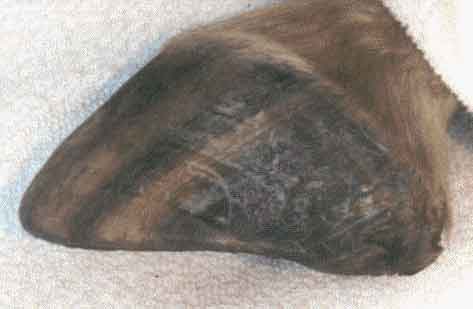 uneven footing. The sole is sensitive enough to allow the horse to feel the ground, increasing sure-footedness, but can callous tough enough to handle the sharpest gravel without bruising or tenderness. Internal structures in the hoof act as perfect natural shock absorbers, cushioning the skeletal joints throughout the body from the bruising force of each thundering foot fall. The natural arch of the hoof, like that in our own feet, allows the horse to move with effortless efficiency, and the rate of growth of the hoof wall actually responds to wear, speeding up when the horse wears the hoof down quickly and slowing down when soft ground produces less wear.
Given this miracle of nature, why would we ever invent metal shoes and nail them onto horses’ hooves?
The short answer, of course, is domestication. Removed from its natural environment, its movement limited and its diet changed, the horse’s hooves cannot function as they were designed. Locked in stalls, soaking in acidic manure and urine, the hooves themselves  begin to break down, and cracks, chips, soft walls, soft soles and rotten frogs appear. Overfed on high-calorie grains and high-sugar, high-starch feeds, horses begin to develop laminitis, white line disease, founder, flares, flat or dropped soles, thrush, thin soles and contracted heels — in short, all the ills the domesticated hoof is heir to.
Given hooves in this shape, horseshoes must have appeared an amazing, life-saving invention: miserably lame horses could, with shoes, now live and work according to human convenience, stalled at night and traversing city streets and farm fields by day. The metal shoes lifted soles and frogs (damaged by urine, lack of movement and too much moisture) off the ground where they could not be bruised as easily, and the hard shoe helped hold together similarly damaged and rotting hoof walls, keeping the hoof intact … as long as the shoe was on.
Take the shoe off, however, and the horse is miserably lame again — because shoes don’t solve the underlying problems, but merely mask them. However, shoes weren’t — and aren’t — the only solution to the problems produced by domestic horse keeping. Return the horse to as natural as an environment as is practical — that is, maximize turnout and movement over a variety of surfaces, limit sugars and starches in the diet, and encourage balanced wear — and those natural, miraculous hooves reappear.
For some folks, this sounds like a lot of unnecessary effort, given that horseshoes make a stalled-with-a-bucket-of-sweet-feed lifestyle possible (which sounds more convenient to some horse owners). However, in addition to only masking the underlying problems, horseshoes create some new problems of their own:
They limit the natural flexibility of the hoof, which is intended to expand both front to back and side to side as the horse’s weight is placed on it, then contract when it is lifted from the ground. This flexibility improves circulation in the hoof, pulling blood into the hoof as it expands and forcing it back out and up the leg as it contracts. A hoof with a shoe nailed to it cannot expand and contract, and thus has limited circulation. Just as limited circulation in people is linked with tissue degeneration and other negative health effects (think diabetic foot loss), so does limited circulation in hooves lead to poor hoof growth, poor horn (hoof wall) quality, decreased ability to fight infection, and degeneration of internal hoof structures.
Shoes directly cause the degeneration of some important internal hoof structures, such as the digital cushion. The digital cushion is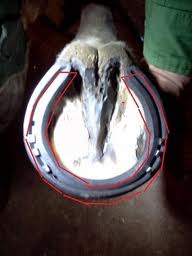 a pad of fat and tendon that sits above the frog and below the coffin bone; at the back of the hoof, it forms the mass of the heel bulbs. It’s function is to support the coffin bone from beneath, as well as to act as a shock absorber. At birth, this pad is mostly fat; however, as the foal’s hoof repeatedly contacts the ground, the concussion causes the body to transform that fat into cartilage and tendons. When a hoof is shod, the sole and frog no longer contact the ground; deprived of that repeated concussion, the digital cushion will ‘deflate,’ losing mass, becoming flatter and returning to fat, and thus leaving the horse without adequate support for the coffin bone (which, remember, is bearing the entire weight of the horse traveling down the bony column of the leg!).
Horseshoes amplify the negative effects of concussion. While it is true that horseshoes deprive the hoof’s sole and frog from the repeated concussion it needs to develop and be healthy, as far as the hoof walls are concerned, the shoes increase concussion, with destructive effects. This may seem like a contradiction, but the difference is in where the concussion occurs. In a natural hoof, the sole and frog help bear the weight of the horse, and therefore the concussive force of each footfall is substantially absorbed by the digital cushion. This helps prevent the jarring vibrations of running over hard ground from traveling up the bones of the leg and damaging the joints and cartilage further up the skeleton. When shod, the sole and frog do not touch the ground, so no shock absorption occurs. In addition, the brittle metal of the shoes can amplify vibrations, and the nails embedded in the hoof wall ensure those vibrations travel directly up into the higher structures of the hoof and leg. Think about the difference between hitting a rock with a piece of wood and hitting that same rock with a bar of metal; the wood, like a hoof, absorbs some of the shock, while the metal transmits its vibrations directly to your hand, resulting in a stinging, buzzing sensation in your palm and wrist.
In addition, nailing metal horseshoes on to the hoof compromises the integrity of the hoof wall, introducing channels through which 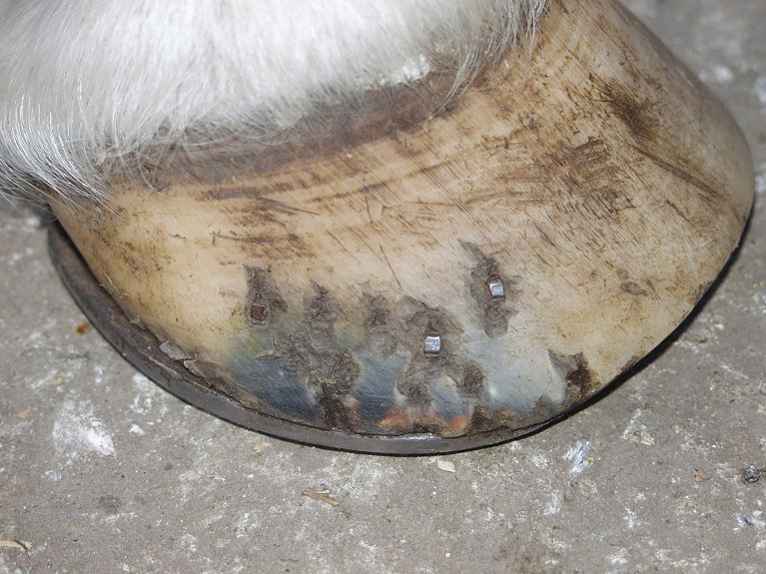 bacteria and fungus can enter the hoof. Given that the decreased circulation in the hoof produces a decreased ability to fight off infection and heal wounds, those small holes can cause big problems — and that’s assuming that they are correctly placed, and not directly in the sensitive laminae of the hoof! That’s what ‘quicking’ a hoof means — driving a nail into the living tissue that holds the hoof wall to the internal structures of the hoof, like driving a toothpick underneath your fingernail.
All of these problems, along with the fact that horseshoes only mask underlying problems, give rise to a vicious cycle: the horse develops weak hooves from its living conditions, so the horse is shod; the shoes add additional stresses and damage to those weak hooves, so when the shoes are pulled, the horse is miserably lame. Since the horse is lame when shoes are pulled, shoes are re-applied, and the damage continues …
Even traditional farriery admit that shoes cause damage; a standard part of farrier education encourages farriers to let horses ‘rest’ during the off season by pulling the shoes and allowing the horse to go barefoot — that is, to give the horse time to recover and heal from the stresses and damage caused by shoeing during the rest of the year.
If horses can go barefoot — and should go barefoot at least some of the time, according even to traditional farriery — and if shoes cause enough damage to the hoof that it requires time off to recover and repair, the question isn’t “why go barefoot?,” but “why shoe at all?”
Want to learn more about going bare? Watch this space — in forthcoming posts I’ll be discussing wild hooves, the history of the barefoot movement, natural diets, natural horsekeeping, shoeing myths, laminitis & other hoof pathologies, and more!
 Red Mare Hoof Care